(-), (–), (—): The punctuation many of us get wrong
Most writers misuse dashes, and don't even know it. Here's a breakdown of the hyphen, en dash, and em dash so you never mix them up again.
If you used ChatGPT 4o, you know how big of a pain the — was. It was like OpenAI grabbed a fistful and tossed it on every Chat like a glitter bomb.
As a writer, it was like nails on a chalkboard every time I hit enter, and — you — would — just — see — this — everywhere.
But then, November 13, 2025 changed everything:
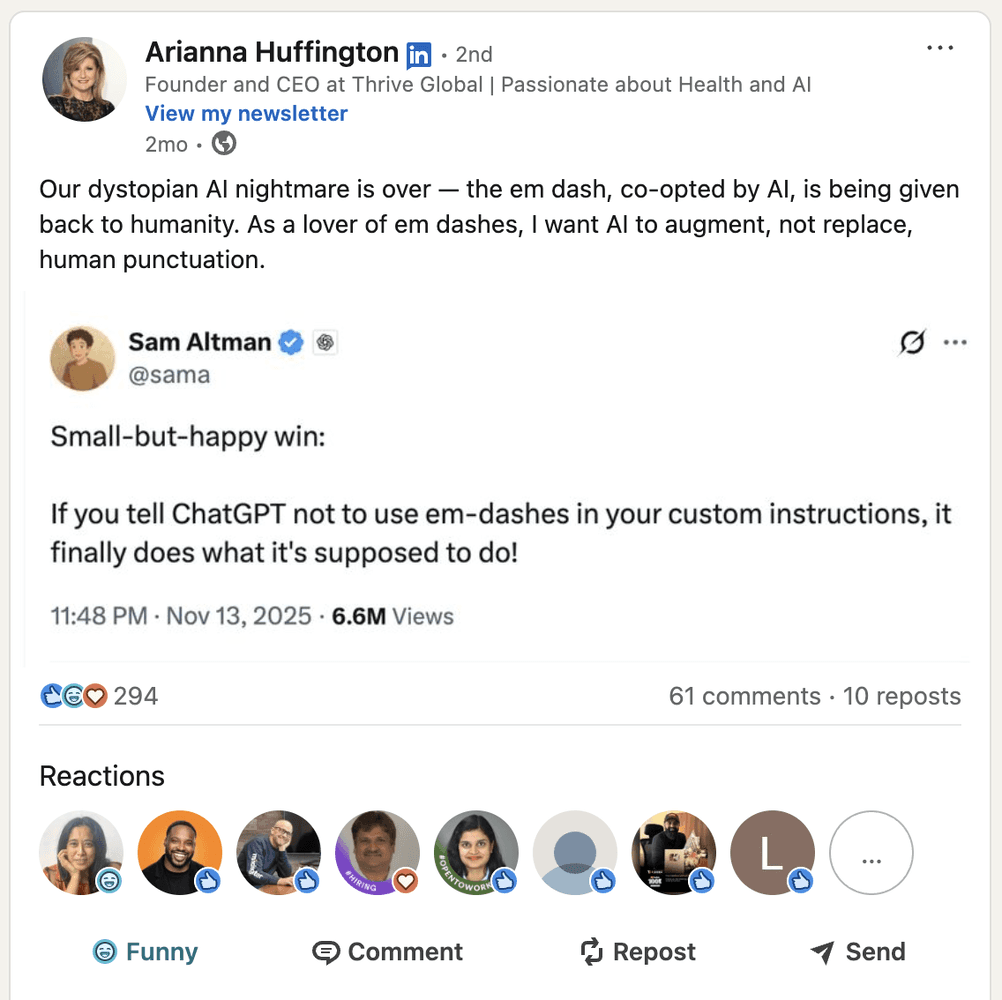
"Does the latest version of ChatGPT affect you?" asked my husband, who saw some post of someone who said that 5.1 was just not following his instructions as well as 4o did.
"No," I replied. "But the latest has gotten rid of the em dash!"
The confused look on his face made me realize he had no idea what an em dash was. So, I started going into explaining it, and the en dash, and the hyphen, and the differences between all of them with as much fervor as a kid in a candy store. (He was not amused.)
It made me wonder, though, how many of us really know what —, –, and - are, and do we really give them the appreciation they deserve?
Fine, yes, okay, they're small and easy to pshhh aside. But the thing is, they're doing far more work in our writing than most people realize.
Why do these teeny, tiny lines matter?
The brain, you see, doesn’t read word by word. It scans for structure first. So what punctuation does is tell it how to group information, where to pause, and what belongs together.
For instance:
this is the story of a shoe a lonely red shoe and the father who went on a mission to reunite it with its pair the lonely red shoe sat by the door every day waiting and wondering where the other shoe had gone maybe under the couch maybe in a bag maybe in the park the father looked everywhere in the closet the car the washing machine and even the backyard he asked the dog he asked the baby he even asked the mailman but no one had seen the other red shoe
How'd you feel reading it? Did your brain throw up its metaphorical hands and scream, "Enough!"?
That’s cognitive load.
Nothing in that story is complex. Rather, the ideas in it are simple. But without punctuation, it's like tossing a box of Legos onto the floor, hoping they assemble themselves into a castle.
Like it or not, no dots, dashes, and slashes, the brain wants to thrashes. And whoever attempts to read such a mess might get tired and crashes.
Now, let's look at the story, written with punctuation, again:
This is the story of a shoe, a lonely red shoe, and the father who went on a mission to reunite it with its pair.
The lonely red shoe sat by the door every day, waiting and wondering where the other shoe had gone. Maybe under the couch? Maybe in a bag? Maybe in the park?
The father looked everywhere—in the closet, the car, the washing machine, and even the backyard. He asked the dog. He asked the baby. He even asked the mailman, but no one had seen the other red shoe.
See how much easier that is on the brain? Because that's what punctuation does.
It shapes meaning, controls pace and rhythm, and tells you how much care went into the words. Not only that, but research shows that people trust information more when it’s easier for the brain to process.
But knowing all this doesn’t change one inconvenient truth: We’re getting it wrong. A lot.
The punctuation problem
Did you know that punctuation mistakes make up a big chunk of writing errors? In fact, one analysis found they account for approximately 40% of all mechanical mistakes in submitted manuscripts. (Forty percent! Can you imagine how exhausted the brain must be by the end of the manuscript?)
Now, if we're talking about the topic at hand, the —, the –, and the -, it seems that the dash wins the gold star for "The Most Frequently Misused." One study found that it was used incorrectly 98.34% of the time. Safe to say, that's almost always.
According to Angus Stevenson, an executive editor at Oxford University Press, people are just not sure how to use punctuation. Specifically highlighting hyphens, he tells World Wide Words that people are "not really sure what they are for."
At one point in time, today was written to-day and teenager was teen-ager. But, as Angus points out, "It's now popping up in places where it was never used before, as in the ubiquitous 'Time to top-up your mobile'."
Why? you might wonder. Well, for a long time, we relied on books, newspapers, and edited writing from professionals. We absorbed the structure because you'd seen it enough times.
Now, most people learn it through texts, emails, social posts, and AI-generated content. And because everything is at Now! Now! Now! pace, punctuation are optional, expressive, or decorative.
Keyboards don’t help either. They're designed in a way that gives you one dash and hides the rest. Writing tools, as well as AI ones, auto-correct without explaining the significance of using —, –, and -. So people guess.
I love how Neetha Mariam Abraham puts it in her TEDx Talk: "There is no doubt that punctuation is crucial when it comes to conveying our messages, and I personally believe that they are the backbones of every sentence. Poor punctuation can obscure it and cause misinterpretations."
Let’s dash this confusion
On to the good stuff: the dashes.
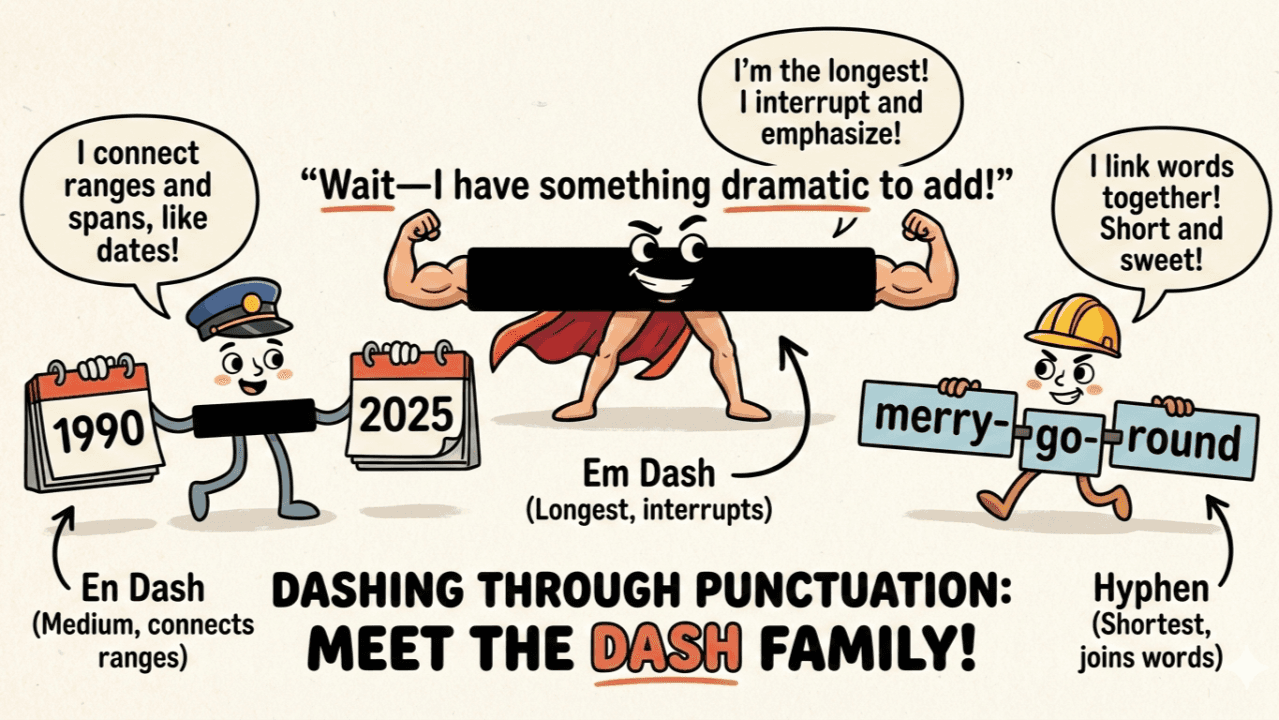
What's the deal with them? Simply, they exist to tell the reader when ideas belong together. And, like the bears of Goldilocks, there are three:
1. The hyphen (-)
The name "hyphen" comes from the Greek word huphen, which roughly meant “one under” or “together as one.”
It's the smallest of the three dashes, and it works inside words. Its job? To glue words together so they read as a single idea instead of separate pieces.
For example: long-term plan
Without the hyphen, the reader has to stop and decide whether “long” describes time or something else. The hyphen removes that hesitation and tells the reader that these words belong together.
In short:
Lives inside words
Holds meaning together
Example: long-term plan
2. The en dash (–)
The en dash is named for its width. You see, back when printing was done with metal letters, printers measured size using the letters themselves. The letter N was one standard width. A dash that wide became known as the en dash.
What it does is work between things. (Now, don't mistake that as inside things. It's between, not inside.) And what this does is to show range or connection.
Think of it as a stand-in for the word to, specifically when you’re talking about spans, distances, or relationships that move from one point to another.
For example: 2019–2024
The en dash tells the reader this covers everything from 2019 to 2024. Not two separate years. A range.
In short:
Lives between words or numbers
Shows range or connection
Example: 2019–2024
3. The em dash (—)
The em dash gets its name the same way the en dash did—by width. In old-school printing, an “em” was the width of the letter M, and a dash that wide became the em dash.
It’s the longest of the three, and it works at the sentence level. Unlike the hyphen or en dash, it doesn’t glue words together or show range. Its job is to manage thought.
The em dash tells the reader to pause, then keep going. It can introduce an explanation, add emphasis, or shift direction without stopping the sentence completely.
For example: The father looked everywhere—the closet, the car, the washing machine, and even the backyard.
In this specific example, the em dash signals that what comes next explains “everywhere.” It's a softer break than a period and a stronger pause than a comma.
In short:
Works between ideas
Creates a strong pause without ending the sentence
Example: The father looked everywhere—the closet, the car, the washing machine, and even the backyard.
It was never just a dash
Sure, we can blame ChatGPT for using em dashes as much as Cher said "As if!" in Clueless. But the thing we have to remember is that LLMs learn from us—emails, posts, messages, and other whatnots we put into the world.
When our writing gets loose, the machines' job isn't to correct it. It's to mimic it. And with dashes all over the place, that just makes our brains work harder than they need to. Dystopian AI nightmare indeed, Arianna Huffington.
So, while dashes just may seem like teeny, tiny lines, they hold a significant weight in how we communicate with each other. That, after all, is the point.
—
This article was written with a little help from AI.
More Reads
Still here? Good. There's more.

(-), (–), (—): The punctuation many of us get wrong
Most writers misuse dashes, and don't even know it. Here's a breakdown of the hyphen, en dash, and em dash so you never mix them up again.
If you used ChatGPT 4o, you know how big of a pain the — was. It was like OpenAI grabbed a fistful and tossed it on every Chat like a glitter bomb.
As a writer, it was like nails on a chalkboard every time I hit enter, and — you — would — just — see — this — everywhere.
But then, November 13, 2025 changed everything:
"Does the latest version of ChatGPT affect you?" asked my husband, who saw some post of someone who said that 5.1 was just not following his instructions as well as 4o did.
"No," I replied. "But the latest has gotten rid of the em dash!"
The confused look on his face made me realize he had no idea what an em dash was. So, I started going into explaining it, and the en dash, and the hyphen, and the differences between all of them with as much fervor as a kid in a candy store. (He was not amused.)
It made me wonder, though, how many of us really know what —, –, and - are, and do we really give them the appreciation they deserve?
Fine, yes, okay, they're small and easy to pshhh aside. But the thing is, they're doing far more work in our writing than most people realize.
Why do these teeny, tiny lines matter?
The brain, you see, doesn’t read word by word. It scans for structure first. So what punctuation does is tell it how to group information, where to pause, and what belongs together.
For instance:
this is the story of a shoe a lonely red shoe and the father who went on a mission to reunite it with its pair the lonely red shoe sat by the door every day waiting and wondering where the other shoe had gone maybe under the couch maybe in a bag maybe in the park the father looked everywhere in the closet the car the washing machine and even the backyard he asked the dog he asked the baby he even asked the mailman but no one had seen the other red shoe
How'd you feel reading it? Did your brain throw up its metaphorical hands and scream, "Enough!"?
That’s cognitive load.
Nothing in that story is complex. Rather, the ideas in it are simple. But without punctuation, it's like tossing a box of Legos onto the floor, hoping they assemble themselves into a castle.
Like it or not, no dots, dashes, and slashes, the brain wants to thrashes. And whoever attempts to read such a mess might get tired and crashes.
Now, let's look at the story, written with punctuation, again:
This is the story of a shoe, a lonely red shoe, and the father who went on a mission to reunite it with its pair.
The lonely red shoe sat by the door every day, waiting and wondering where the other shoe had gone. Maybe under the couch? Maybe in a bag? Maybe in the park?
The father looked everywhere—in the closet, the car, the washing machine, and even the backyard. He asked the dog. He asked the baby. He even asked the mailman, but no one had seen the other red shoe.
See how much easier that is on the brain? Because that's what punctuation does.
It shapes meaning, controls pace and rhythm, and tells you how much care went into the words. Not only that, but research shows that people trust information more when it’s easier for the brain to process.
But knowing all this doesn’t change one inconvenient truth: We’re getting it wrong. A lot.
The punctuation problem
Did you know that punctuation mistakes make up a big chunk of writing errors? In fact, one analysis found they account for approximately 40% of all mechanical mistakes in submitted manuscripts. (Forty percent! Can you imagine how exhausted the brain must be by the end of the manuscript?)
Now, if we're talking about the topic at hand, the —, the –, and the -, it seems that the dash wins the gold star for "The Most Frequently Misused." One study found that it was used incorrectly 98.34% of the time. Safe to say, that's almost always.
According to Angus Stevenson, an executive editor at Oxford University Press, people are just not sure how to use punctuation. Specifically highlighting hyphens, he tells World Wide Words that people are "not really sure what they are for."
At one point in time, today was written to-day and teenager was teen-ager. But, as Angus points out, "It's now popping up in places where it was never used before, as in the ubiquitous 'Time to top-up your mobile'."
Why? you might wonder. Well, for a long time, we relied on books, newspapers, and edited writing from professionals. We absorbed the structure because you'd seen it enough times.
Now, most people learn it through texts, emails, social posts, and AI-generated content. And because everything is at Now! Now! Now! pace, punctuation are optional, expressive, or decorative.
Keyboards don’t help either. They're designed in a way that gives you one dash and hides the rest. Writing tools, as well as AI ones, auto-correct without explaining the significance of using —, –, and -. So people guess.
I love how Neetha Mariam Abraham puts it in her TEDx Talk: "There is no doubt that punctuation is crucial when it comes to conveying our messages, and I personally believe that they are the backbones of every sentence. Poor punctuation can obscure it and cause misinterpretations."
Let’s dash this confusion
On to the good stuff: the dashes.
What's the deal with them? Simply, they exist to tell the reader when ideas belong together. And, like the bears of Goldilocks, there are three:
1. The hyphen (-)
The name "hyphen" comes from the Greek word huphen, which roughly meant “one under” or “together as one.”
It's the smallest of the three dashes, and it works inside words. Its job? To glue words together so they read as a single idea instead of separate pieces.
For example: long-term plan
Without the hyphen, the reader has to stop and decide whether “long” describes time or something else. The hyphen removes that hesitation and tells the reader that these words belong together.
In short:
Lives inside words
Holds meaning together
Example: long-term plan
2. The en dash (–)
The en dash is named for its width. You see, back when printing was done with metal letters, printers measured size using the letters themselves. The letter N was one standard width. A dash that wide became known as the en dash.
What it does is work between things. (Now, don't mistake that as inside things. It's between, not inside.) And what this does is to show range or connection.
Think of it as a stand-in for the word to, specifically when you’re talking about spans, distances, or relationships that move from one point to another.
For example: 2019–2024
The en dash tells the reader this covers everything from 2019 to 2024. Not two separate years. A range.
In short:
Lives between words or numbers
Shows range or connection
Example: 2019–2024
3. The em dash (—)
The em dash gets its name the same way the en dash did—by width. In old-school printing, an “em” was the width of the letter M, and a dash that wide became the em dash.
It’s the longest of the three, and it works at the sentence level. Unlike the hyphen or en dash, it doesn’t glue words together or show range. Its job is to manage thought.
The em dash tells the reader to pause, then keep going. It can introduce an explanation, add emphasis, or shift direction without stopping the sentence completely.
For example: The father looked everywhere—the closet, the car, the washing machine, and even the backyard.
In this specific example, the em dash signals that what comes next explains “everywhere.” It's a softer break than a period and a stronger pause than a comma.
In short:
Works between ideas
Creates a strong pause without ending the sentence
Example: The father looked everywhere—the closet, the car, the washing machine, and even the backyard.
It was never just a dash
Sure, we can blame ChatGPT for using em dashes as much as Cher said "As if!" in Clueless. But the thing we have to remember is that LLMs learn from us—emails, posts, messages, and other whatnots we put into the world.
When our writing gets loose, the machines' job isn't to correct it. It's to mimic it. And with dashes all over the place, that just makes our brains work harder than they need to. Dystopian AI nightmare indeed, Arianna Huffington.
So, while dashes just may seem like teeny, tiny lines, they hold a significant weight in how we communicate with each other. That, after all, is the point.
—
This article was written with a little help from AI.
More Reads
Still here? Good. There's more.
(-), (–), (—): The punctuation many of us get wrong
Most writers misuse dashes, and don't even know it. Here's a breakdown of the hyphen, en dash, and em dash so you never mix them up again.
If you used ChatGPT 4o, you know how big of a pain the — was. It was like OpenAI grabbed a fistful and tossed it on every Chat like a glitter bomb.
As a writer, it was like nails on a chalkboard every time I hit enter, and — you — would — just — see — this — everywhere.
But then, November 13, 2025 changed everything:
"Does the latest version of ChatGPT affect you?" asked my husband, who saw some post of someone who said that 5.1 was just not following his instructions as well as 4o did.
"No," I replied. "But the latest has gotten rid of the em dash!"
The confused look on his face made me realize he had no idea what an em dash was. So, I started going into explaining it, and the en dash, and the hyphen, and the differences between all of them with as much fervor as a kid in a candy store. (He was not amused.)
It made me wonder, though, how many of us really know what —, –, and - are, and do we really give them the appreciation they deserve?
Fine, yes, okay, they're small and easy to pshhh aside. But the thing is, they're doing far more work in our writing than most people realize.
Why do these teeny, tiny lines matter?
The brain, you see, doesn’t read word by word. It scans for structure first. So what punctuation does is tell it how to group information, where to pause, and what belongs together.
For instance:
this is the story of a shoe a lonely red shoe and the father who went on a mission to reunite it with its pair the lonely red shoe sat by the door every day waiting and wondering where the other shoe had gone maybe under the couch maybe in a bag maybe in the park the father looked everywhere in the closet the car the washing machine and even the backyard he asked the dog he asked the baby he even asked the mailman but no one had seen the other red shoe
How'd you feel reading it? Did your brain throw up its metaphorical hands and scream, "Enough!"?
That’s cognitive load.
Nothing in that story is complex. Rather, the ideas in it are simple. But without punctuation, it's like tossing a box of Legos onto the floor, hoping they assemble themselves into a castle.
Like it or not, no dots, dashes, and slashes, the brain wants to thrashes. And whoever attempts to read such a mess might get tired and crashes.
Now, let's look at the story, written with punctuation, again:
This is the story of a shoe, a lonely red shoe, and the father who went on a mission to reunite it with its pair.
The lonely red shoe sat by the door every day, waiting and wondering where the other shoe had gone. Maybe under the couch? Maybe in a bag? Maybe in the park?
The father looked everywhere—in the closet, the car, the washing machine, and even the backyard. He asked the dog. He asked the baby. He even asked the mailman, but no one had seen the other red shoe.
See how much easier that is on the brain? Because that's what punctuation does.
It shapes meaning, controls pace and rhythm, and tells you how much care went into the words. Not only that, but research shows that people trust information more when it’s easier for the brain to process.
But knowing all this doesn’t change one inconvenient truth: We’re getting it wrong. A lot.
The punctuation problem
Did you know that punctuation mistakes make up a big chunk of writing errors? In fact, one analysis found they account for approximately 40% of all mechanical mistakes in submitted manuscripts. (Forty percent! Can you imagine how exhausted the brain must be by the end of the manuscript?)
Now, if we're talking about the topic at hand, the —, the –, and the -, it seems that the dash wins the gold star for "The Most Frequently Misused." One study found that it was used incorrectly 98.34% of the time. Safe to say, that's almost always.
According to Angus Stevenson, an executive editor at Oxford University Press, people are just not sure how to use punctuation. Specifically highlighting hyphens, he tells World Wide Words that people are "not really sure what they are for."
At one point in time, today was written to-day and teenager was teen-ager. But, as Angus points out, "It's now popping up in places where it was never used before, as in the ubiquitous 'Time to top-up your mobile'."
Why? you might wonder. Well, for a long time, we relied on books, newspapers, and edited writing from professionals. We absorbed the structure because you'd seen it enough times.
Now, most people learn it through texts, emails, social posts, and AI-generated content. And because everything is at Now! Now! Now! pace, punctuation are optional, expressive, or decorative.
Keyboards don’t help either. They're designed in a way that gives you one dash and hides the rest. Writing tools, as well as AI ones, auto-correct without explaining the significance of using —, –, and -. So people guess.
I love how Neetha Mariam Abraham puts it in her TEDx Talk: "There is no doubt that punctuation is crucial when it comes to conveying our messages, and I personally believe that they are the backbones of every sentence. Poor punctuation can obscure it and cause misinterpretations."
Let’s dash this confusion
On to the good stuff: the dashes.
What's the deal with them? Simply, they exist to tell the reader when ideas belong together. And, like the bears of Goldilocks, there are three:
1. The hyphen (-)
The name "hyphen" comes from the Greek word huphen, which roughly meant “one under” or “together as one.”
It's the smallest of the three dashes, and it works inside words. Its job? To glue words together so they read as a single idea instead of separate pieces.
For example: long-term plan
Without the hyphen, the reader has to stop and decide whether “long” describes time or something else. The hyphen removes that hesitation and tells the reader that these words belong together.
In short:
Lives inside words
Holds meaning together
Example: long-term plan
2. The en dash (–)
The en dash is named for its width. You see, back when printing was done with metal letters, printers measured size using the letters themselves. The letter N was one standard width. A dash that wide became known as the en dash.
What it does is work between things. (Now, don't mistake that as inside things. It's between, not inside.) And what this does is to show range or connection.
Think of it as a stand-in for the word to, specifically when you’re talking about spans, distances, or relationships that move from one point to another.
For example: 2019–2024
The en dash tells the reader this covers everything from 2019 to 2024. Not two separate years. A range.
In short:
Lives between words or numbers
Shows range or connection
Example: 2019–2024
3. The em dash (—)
The em dash gets its name the same way the en dash did—by width. In old-school printing, an “em” was the width of the letter M, and a dash that wide became the em dash.
It’s the longest of the three, and it works at the sentence level. Unlike the hyphen or en dash, it doesn’t glue words together or show range. Its job is to manage thought.
The em dash tells the reader to pause, then keep going. It can introduce an explanation, add emphasis, or shift direction without stopping the sentence completely.
For example: The father looked everywhere—the closet, the car, the washing machine, and even the backyard.
In this specific example, the em dash signals that what comes next explains “everywhere.” It's a softer break than a period and a stronger pause than a comma.
In short:
Works between ideas
Creates a strong pause without ending the sentence
Example: The father looked everywhere—the closet, the car, the washing machine, and even the backyard.
It was never just a dash
Sure, we can blame ChatGPT for using em dashes as much as Cher said "As if!" in Clueless. But the thing we have to remember is that LLMs learn from us—emails, posts, messages, and other whatnots we put into the world.
When our writing gets loose, the machines' job isn't to correct it. It's to mimic it. And with dashes all over the place, that just makes our brains work harder than they need to. Dystopian AI nightmare indeed, Arianna Huffington.
So, while dashes just may seem like teeny, tiny lines, they hold a significant weight in how we communicate with each other. That, after all, is the point.
—
This article was written with a little help from AI.
More Reads
Still here? Good. There's more.